Description
Redesign and Improvements
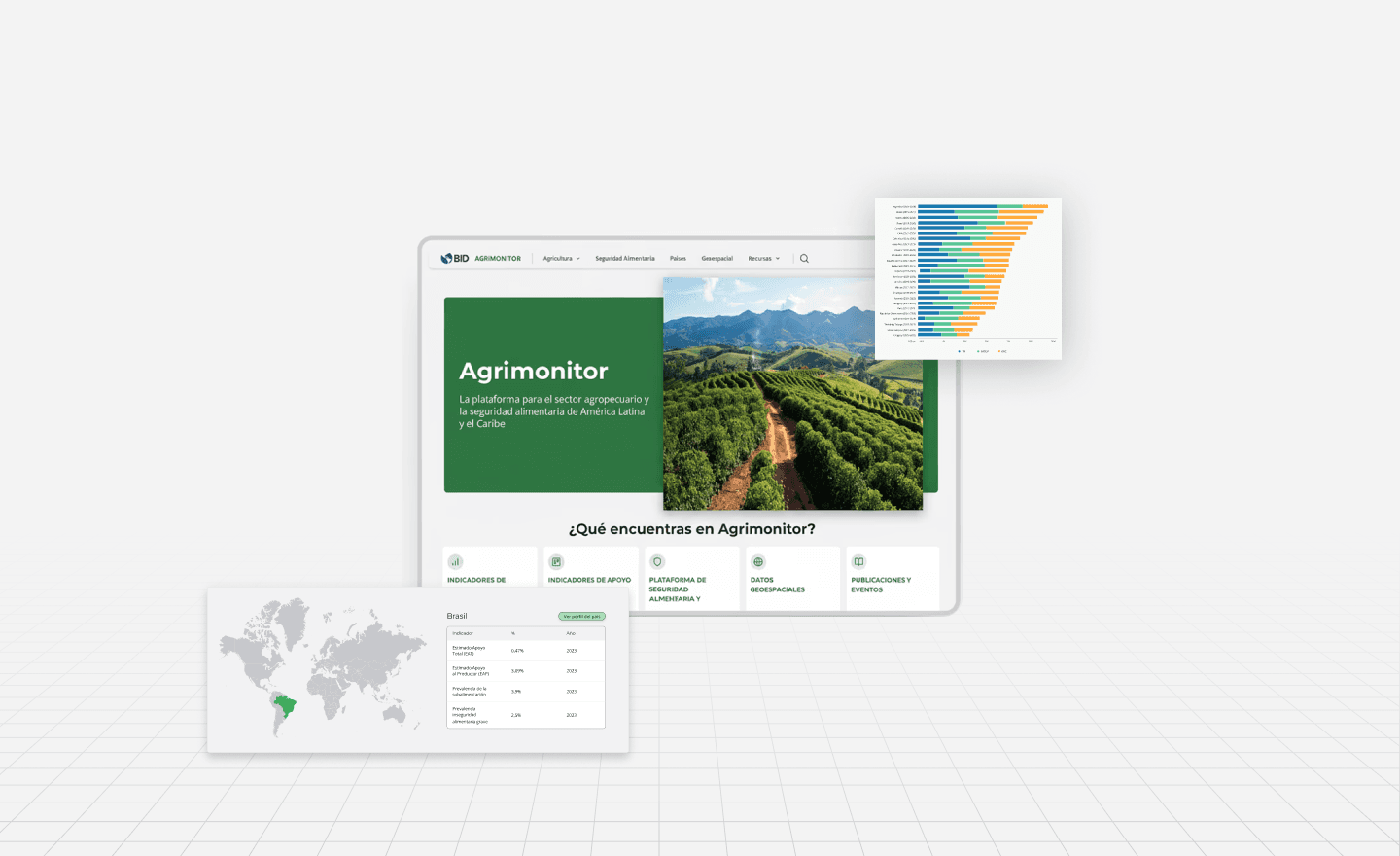
Agrimonitor is an IDB platform that centralizes data on agricultural policy, productivity, food security, and nutrition across Latin America and the Caribbean. Faced with the need to incorporate new thematic areas and a user base that had outgrown the original design, I led a full redesign as the Product Designer, owning the end-to-end UX/UI process—from research to final implementation.
The work focused on modernizing the interface, integrating geospatial layers, and rebuilding the experience from the ground up around how people actually use the data.
Product Strategy
The redesign expanded Agrimonitor's scope to cover food security, nutrition, and geospatial policy data—while making existing content meaningfully easier to explore. We rebuilt the information architecture to support navigation by country, theme, or timeline, and introduced a modular structure that can absorb future content without fragmenting the experience. The new architecture reduced the average number of clicks to reach a target indicator from 7 to 3.
UX Research: 30 Interviews, 4 User Groups
We ran 30 in-depth interviews across four distinct user profiles, because Agrimonitor's audience is not monolithic—and designing for one group at the expense of others was a core failure of the previous platform.
Technical users and policy analysts needed raw data access, export capabilities, and methodological transparency. They were power users frustrated by slow load times and inconsistent data labeling.
University researchers and students needed contextual framing, comparative tools, and clear sourcing. Many were using the platform for the first time and struggled to understand what each indicator actually measured.
Journalists and communicators needed shareable, embeddable visuals and quick country-level snapshots. They had the least tolerance for complexity and the highest abandonment rate on the previous site—over 80% left without finding what they came for.
Sector specialists (agronomists, nutritionists, food security experts) needed depth, cross-indicator analysis, and geospatial context. They were the most engaged users but reported that the old platform undersupported their actual workflows.
These interviews surfaced a consistent pattern: users knew Agrimonitor had the data they needed—they just couldn't find it. Task completion rate on the original platform averaged 34% across user groups. Post-redesign, it reached 79%.
Usability Testing on the Previous Platform
Before designing a single new screen, we ran structured usability tests on the existing platform with 18 participants across the four groups. Key findings: 72% of users failed to locate a specific country indicator without assistance, average session time was high (8.3 minutes) but correlated with frustration rather than engagement, and the mobile experience had a 91% drop-off rate after the first page. These benchmarks became the baseline against which every redesign decision was measured.
UX Process
With the research grounded in real behavior, we moved into architecture and flow design. Navigation was restructured around three entry points—by country, by theme, and by indicator—reflecting the three dominant mental models that emerged from interviews. We reduced cognitive load through progressive disclosure, showing summary-level data first with optional depth for those who need it. This directly addressed the gap between specialist and non-specialist users without creating parallel experiences.
UI Design
We built a modern, clean interface with a scalable visual system—interactive charts, geospatial map layers, and comparative dashboards that let users analyze indicators across countries and over time. Typography, color, and layout were tuned for data readability across devices, with mobile performance improving from a 9% to a 61% task completion rate. The design also aligns with IDB's broader platform ecosystem, enabling future interoperability without visual inconsistency.
The result is a platform that serves a policy analyst exporting a dataset and a journalism student building a story—without compromising either.
