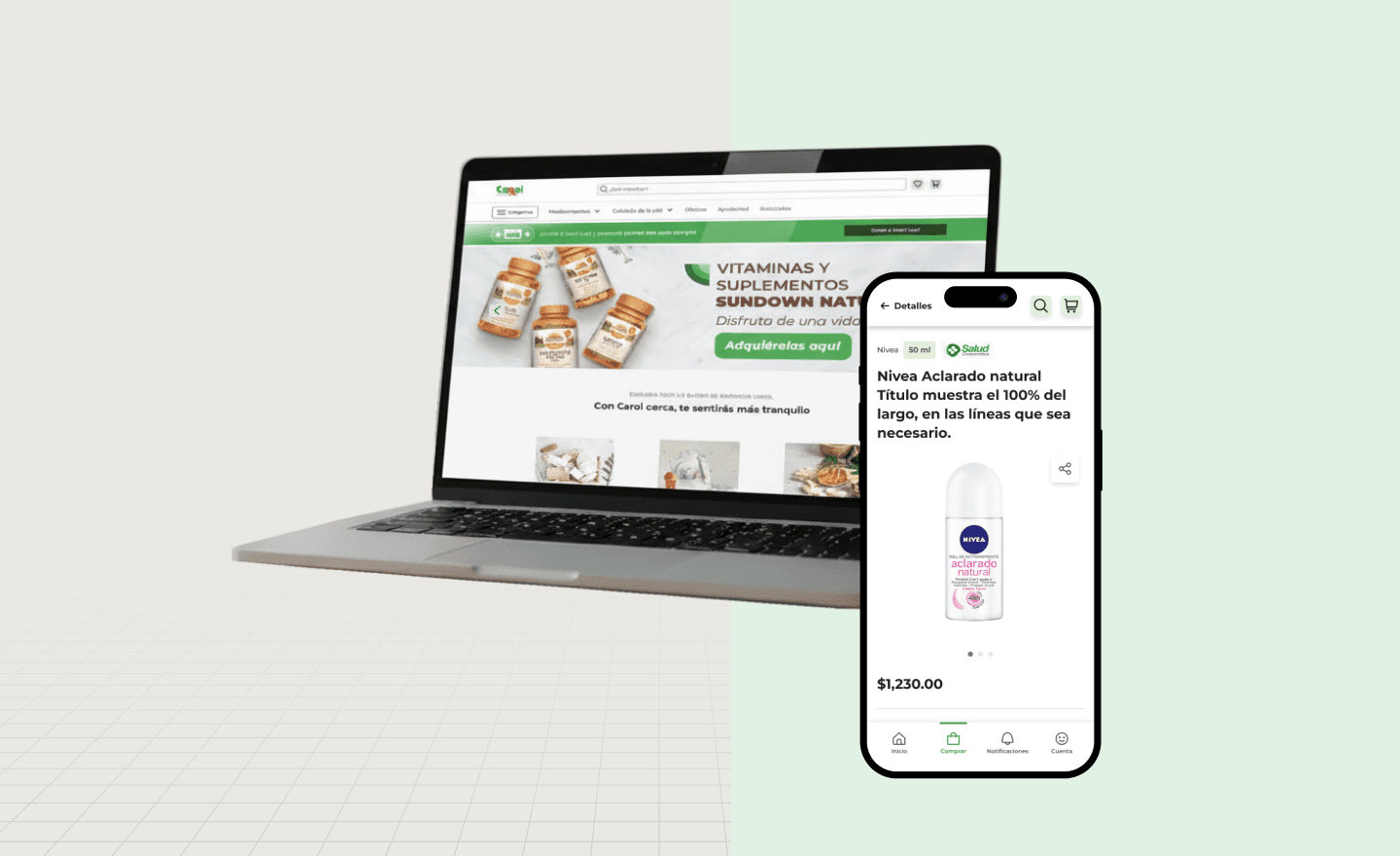
Description
Farmacia Carol is a pharmacy chain in the Dominican Republic with physical stores and an online presence. When we took on the project, their e-commerce was built on a fragile WordPress setup with disconnected plugins, no design consistency, and serious performance problems. The business was losing customers at every step of the funnel — from slow page loads to a checkout experience that created more confusion than confidence.
This case study covers the full scope: initial audit, user research, redesign of the purchase experience, creation of a UI design system, and the migration from WordPress to Adobe Commerce.
The core business problem: conversion rate was at 0.8% — well below the 2–3% benchmark for the category. Cart abandonment sat at 74%. The operations team needed 3 people and ~45 minutes per product to manage catalog updates.
Discovery & Research
Before touching the interface, we needed to understand where and why users were leaving — and what the operations team was dealing with internally.
Heuristic audit
We ran a full heuristic evaluation against Nielsen's 10 usability principles. The most critical violations: no visual hierarchy on product pages, a 6-step checkout with no progress indicator and no guest purchase option, broken mobile layout on most category pages, and trust signals buried in the footer.
User interviews
We conducted 8 moderated remote interviews with users who buy health and pharmacy products online at least once a month. Three findings shaped the entire redesign:
Users weren't unsure about the products — they were unsure about the pharmacy. Most participants mentioned looking for proof that this was a legitimate, licensed pharmacy before completing a purchase.
For medication specifically, users needed to see dosage, format, and quantity on the product card itself. Without it, they were opening 4–5 product pages before finding the right one.
Users who reached the cart had strong purchase intent — but the account creation wall before checkout caused significant drop-off. "I just want to buy, I don't want to register" came up in almost every session.
Analytics review
90 days of data confirmed the interviews: 64% of sessions ended on category pages, the account creation step had a 51% abandonment rate, and mobile accounted for 71% of sessions but only 28% of completed purchases.
Design Strategy
Three principles guided every decision:
Clarity over completeness. Show only what the user needs to decide — not everything available. Product pages needed less content, better organized.
Trust must be visible. Trust signals needed to appear at the moments of highest anxiety — product page and checkout — not just the footer.
Remove gates from the purchase path. Guest checkout was non-negotiable. Account creation needed to be an offer after purchase, not a wall before it.
Operational efficiency is a design problem. The content team was burning hours on manual catalog updates. The design system needed to solve this, not just the customer-facing UI.
Information Architecture
The original site had 14 top-level navigation categories with no hierarchy and inconsistent naming. We ran a card sorting session with 12 participants to understand how users mentally organize pharmacy products.
The new architecture reduced top-level categories from 14 to 5, with consistent second and third-level taxonomy across all sections. This directly reduced category page abandonment post-launch.
UI Design & Design System
We built the design system before designing any screens — 38 base components covering product cards, CTAs, form fields, badges, navigation, and notification states, each documented with usage rules and responsive behavior.
Key redesign decisions:
The product card was redesigned to show everything needed for a basic decision without opening the detail page. Trust signals moved from footer to product page and checkout. Checkout reduced from 6 steps to 3, with account creation becoming an optional single-click action on the confirmation screen. Category filters were rebuilt to show active filters as dismissible tags above results.
Usability Testing
Before launch, we ran moderated sessions with 5 participants matching the target profile. Task completion for the checkout flow reached 5/5 — in our discovery sessions on the old site, only 3 of 8 users had completed it.
Two iterations came out of testing: a pharmacy license number added to the homepage header, and dosage filters moved from a dropdown to a persistent chip row on mobile.